There are some persistent misconceptions in the history of jewellery. The one I am about to explain dates back to the publication of a book that is nonetheless a major work in the history of jewellery: Cartier by Hans Nadelhoffer. Since then, the error contained in this book has persisted because the majority of authors simply copy from older works without going to the source of the information. However, and I would like to reiterate this, this book, along with those by Francesca Cartier Brickell and Olivier Bachet & Alain Cartier, remains one of the key reference works on the House of Cartier. Nadelhoffer’s book is all the more important as it forms the basis of all bibliographies devoted to the panther brand. Indeed, it is the first book written independently on the house and the result of several years of research at a time when heritage was not a priority. The problem is that this error is repeated in Nadelhoffer’s reprints, including the 1999 edition, as well as in Christian Rosset’s 1996 book and in more recent works. Many free databases repeat the error, and Le Dictionnaire des Poinçons, published in 2024, does not clearly clarify the situation. Now, if you have ever come across these hallmarks on Cartier jewellery (the panther, that is), I would be grateful for your photos to help me continue my research.
When writing, one must make do with the sources and archives available at a given moment. More than forty years have passed between the book’s publication in 1984 and today, and archive sources that were unavailable at the time are now accessible. Let us add that access to genealogical documents has become much more widespread, and it is now far easier to trace a company’s history using the research databases that historians use on a daily basis.
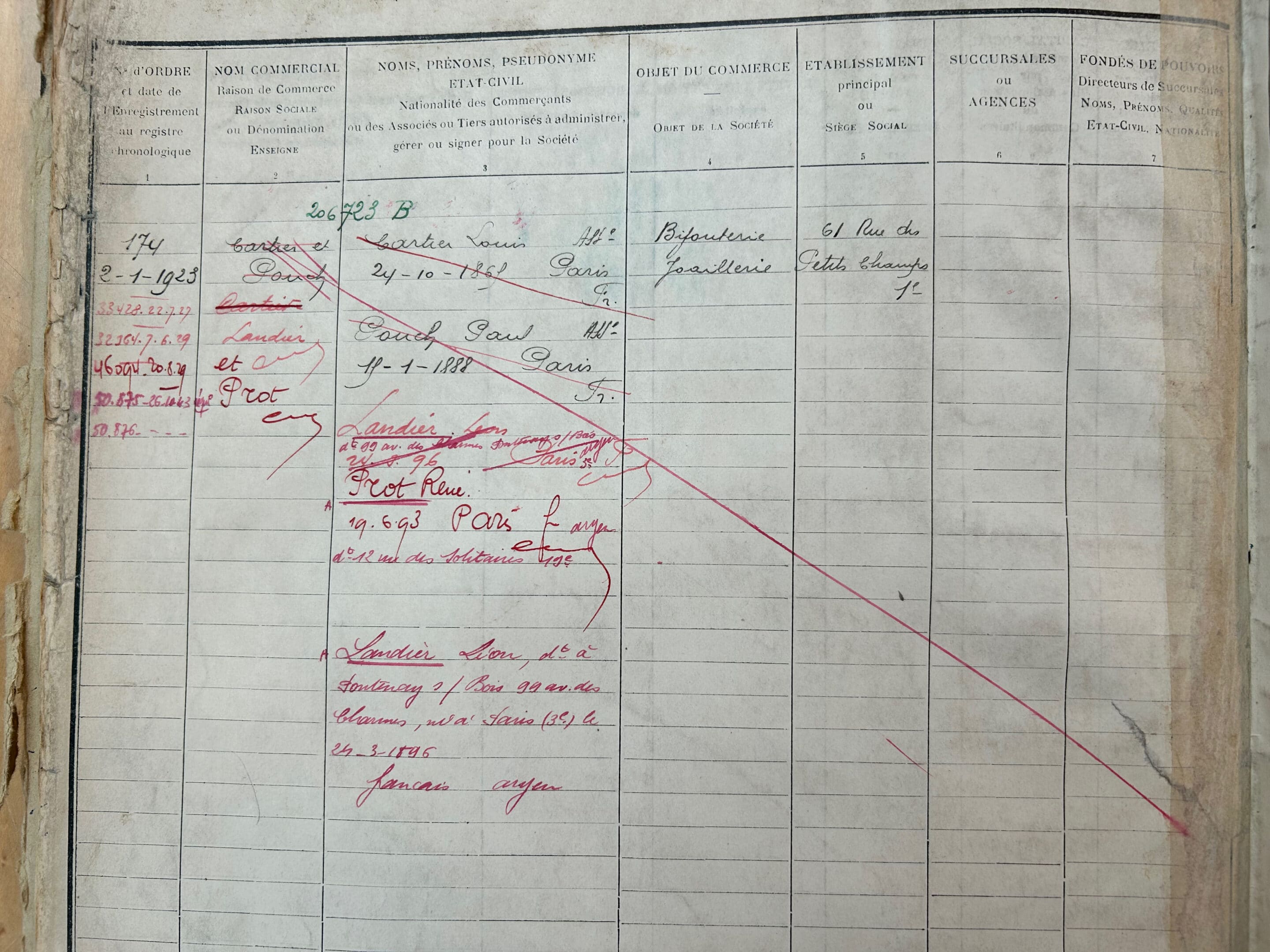
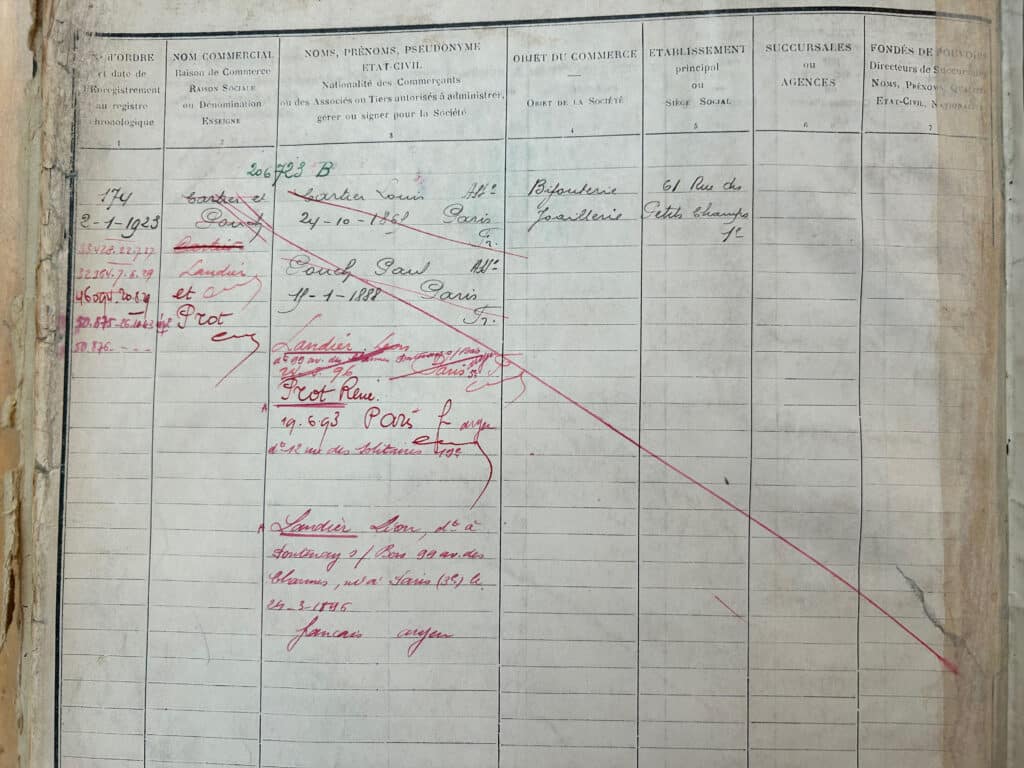
Writing a company’s history requires a methodical approach. And the majority of the archives that we historians work with are often not very exciting: the documents are fragile, sometimes incomplete, often damaged, and mostly difficult to decipher; we can spend hours with our magnifying glasses trying to read the handwritten or pen annotations in the margins of various and varied records.
We are, however, incredibly lucky in France: we have exceptionally efficient archive services and a meticulous administration. Whilst we often criticise the way it operates, it has one particular quality: it keeps records. And it keeps a lot of them. An enormous amount, in fact. It produces files, registers, collections and a vast number of records that must be sifted through to understand the administrative history of a person or a company. So, no, it isn’t always pleasant to delve into dusty boxes filled with documents that are falling to pieces. And yet, it is necessary.
And that is exactly the story I am about to tell you, so that we can finally stop attributing certain master’s hallmarks to the House of Cartier. Yet, even though things are clearly explained on the ResearchJewel database, these hallmarks are still cited in recent works as belonging to Cartier, the one on Rue de la Paix, that is.
To make sense of this confusion, you’ll need to follow me through the French administrative records, freely available at the Paris Archives (mainly the D33U3 collection) and the National Archives. Our story begins in 1865… On 24 October 1865, a child named Louis Isidore Cartier was born in the 19th arrondissement. His parents were Frédéric Cartier and Fannie Joséphine Marie Cohin. As his father was Swiss (he was born in Rolle in the canton of Vaud), he was naturalised as a French citizen on 13 December 1893. He had several brothers and sisters, including (and I shall return to this) Julien Théophile.
Where the story gets a bit complicated is that his father was a jeweller. Don’t look for links to the other Cartier family; I haven’t found any going back several generations, so I sincerely believe they are simply namesakes (I’ve even identified another Louis Cartier, a goldsmith in 1793). However, to be precise, bear in mind that Louis Joseph Cartier (the one from the Cartier house on Rue de la Paix) was born on 6 June 1875 in the 17th arrondissement, that his parents were named Louis Alfred François Cartier and Alice Amélie Griffeuille, and that he had two brothers and a sister: Jacques, Pierre and Suzanne.
As Louis Isidore Cartier’s father was a jeweller, he too became a jeweller. Nothing out of the ordinary. But as you may have already realised: between a Louis Cartier born in 1865 and a Louis Cartier born in 1875, it’s enough to make one’s head spin. At the age of 38, the first Louis Cartier (the one born in 1865) set up his own business by founding his first company: Cartier & Ader.
1- Cartier & Ader

The company was registered by a private deed dated 5 October 1903 and declared to have commenced operations on 1 September 1903. This explains why the firm’s hallmark was engraved by the Paris customs authorities on 23 September 1903. It features the letters C&A, with a crescent moon on a background of earth. It is worth noting that the majority of hallmarks are pictorial and inspired by family names. The hallmark actually depicts a crescent moon or a phase of the moon (Cartier / Moon quarter).
The two men set up a partnership for a period of 10 years. At that time, Louis I. Cartier was a tenant at 55 Rue de Belleville in the 19th arrondissement of Paris, and Aurélien Ader lived at 11 Rue Rameau in the 2nd arrondissement, a stone’s throw from the Palais Royal, the jewellers’ quarter before the 9th arrondissement took over that role a few years later, driven – among other factors – by the Armenian community. It is at this address that they registered the company’s head office, though the business was actually based at 61 Rue des Petits-Champs in the 1st arrondissement. Do bear this address in mind, as I shall return to it later. There is no trace of the company in the land register, as the two men were tenants at this address and tenants rarely feature in this archive. Little is known about Aurélien Ader, except that he was a draughtsman and had been a member of the Chambre Syndicale, where he received an award in 1899, aged 20.
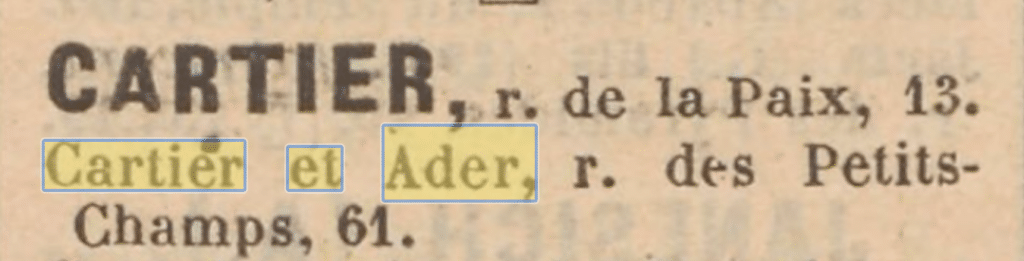
Several advertising entries exist, for example in 1907 and 1911, where the company appears under the name of the House of Cartier (the other one, that is). Possibly to capitalise on the name, but also simply because when listed in directories, the order is alphabetical. And so two Cartier firms appear in the same categories: jewellers.
On 7 April 1910, the company was listed in a retrospective advertisement in the Petites Affiches, where we learn that it had a share capital of 7,000 francs. It was finally dissolved on 15 April 1913, and the legal notice was published on 7 May 1913, with registration dated 1 May of the same year. The reasons for the dissolution are unknown; however, on 12 December 1912, Aurélien Ader (a widower from a previous marriage) married Émilie Tissier. The couple, who were living at the same address as Cartier & Ader, left Paris shortly afterwards. This change in their personal lives likely led to a change in their professional lives.
Between these two dates, the company filed two patents, available in the INPI databases, for extendable bracelets which we would very much like to see. The company appeared regularly in the press of the time and employed several staff: we learn that the workers supported the strikers in Fougères during the Great Strike of the winter of 1906–1907, and that André Fénot, a jeweller at the firm, received an award from the Société d’Encouragement par l’Orphelinat de la Bijouterie in 1909.
With the company’s impending dissolution, the hallmark was struck off on 1 April 1913. But Louis Isidore Cartier did not stop there and went on to establish a new firm.
2- Louis Isidore Cartier, on his own.

Following the dissolution of Cartier & Ader, Louis Isidore Cartier continued to work as a jeweller. He had a new hallmark engraved: LC a crescent on a globe dated 15 April 1913, the date marking the end of the previous firm. He retained the same address on Rue des Petits-Champs. In 1914, he is listed as the sole proprietor in the Bottin du Commerce, where he appears below the Cartier firm on Rue de la Paix.
He struck out his hallmark dated 3 July 1919 as a new company was about to be established.
3- Louis Cartier & Cie.


On 1 July 1920, Louis Isidore Cartier went into partnership with his brother Julien Théophile. The general partnership, which was due to end on 30 June 1925, did not change its address or corporate purpose and continued to be engaged in the ‘manufacture of jewellery’. Alas, this partnership, with a share capital of 10,000 francs, did not last until 1925; it was dissolved on 3 January 1923.
This firm possessed a hallmark unfortunately registered under the name Cartier & Cohen, though it is more likely to be Cartier & Cartier, i.e. CC – a crescent / a crescent on the earth (an inconsistency remains regarding the reality of the discrepancy). Indeed, searches in the commercial register have failed to identify a company named Cartier & Cohen or Cartier Cohen at the address 61 Rue des Petits-Champs in Paris. The hallmark was first used on 8 August 1919 and was struck out on 2 April 1922, a few weeks before the Cartier & Pouch hallmark was struck. The reason for the hallmark being struck several months before the company’s registration is undoubtedly due to a very specific administrative requirement: the creation of the Commercial Register in 1920, which introduced a mandatory registration requirement for businesses from 28 June 1920. By 1 July of that same year, the Cartier brothers had therefore brought their affairs into order. Until that date, businesses were not subject to the same obligations as they are today. This regularly explains the difficulties in tracing companies.
As for Julien Théophile, we know from his birth certificate that he was born on 24 April 1867, at 20 Rue de la Mare in the 20th arrondissement of Paris, and that he had the same parents as Louis Isidore. The two men were therefore indeed brothers. We know very little about him, but at the time of his death in 1938, he was a widower and unemployed.
4- Cartier & Pouch

On 10 March 1922, a new general partnership of indefinite duration was established. Louis Isidore Cartier went into partnership with Paul Pouch, born on 15 January 1888 in Paris. The two men raised 10,000 francs in share capital. On 25 June 1927, the company became a limited liability company (SARL) and also saw its share capital increase from 10,000 francs to 30,000 francs.
The company remained at 61 Rue des Petits-Champs, and a new hallmark was introduced on 3 April 1922: C&P, a crescent on a globe. It was struck out a few years later – on 23 May 1929 – during yet another administrative change.
Few records of the firm have survived, but the minutes of the Jewellers’ Trade Association reveal that Max Bastoen received a prize of 100 francs for his costume jewellery at the 1925 Young Craftsmen’s Competition.
5- Cartier & Landier then Landier & Prot


On 13 April 1929, Paul Pouch and Louis I. Cartier sold shares to Léon Landier, born on 24 March 1896 in the 3rd arrondissement of Paris. The company then became Cartier & Landier with a share capital of 30,000 francs. A new hallmark was introduced, registered on 19 July 1929, retaining the distinctive feature of the previous ones: CL a crescent on the earth.
This hallmark lasted only a few months, as the Commercial Register records indicate that Louis Isidore Cartier left the company on 7 June 1929. More specifically, on 1 August, Cartier sold his shares to René Prot, who also acquired shares from Léon Landier, and the firm became Landier & Prot. The share capital increased significantly to 32,000 francs. The new hallmark was then engraved between November and December 1929: L&P a crescent on the earth. The story continued with a further change on 1 January 1941, when the company sold the majority of its assets to Philippot & Cie. A new hallmark was introduced, featuring a fish as its symbol, and the crescent on the earth was gone for good….

Tracing the history of a company can sometimes (and often) prove complicated. Dates overlap, and one must understand which dates correspond to the start of operations and which to administrative registrations, which are often different from the dates of publication of official commercial notices. Added to this initial complexity are the dates of engraving and striking out of hallmarks, which may not exactly correspond to the administrative dates.
For example, in the first half of the 20th century, it was not uncommon to obtain a hallmark after the start of operations but before registration with the Registry. Similarly, hallmarks could be struck out before or after registration. And, whilst the dates often follow one another, it is common for them to overlap, complicating the interpretation of the administrative history of commercial organisations. The case of Cartier & Ader and their successors is a classic example of a lack of familiarity with French archives and the copying of information without verifying the source. I hope this article will help to limit such errors in future. And if you ever come across jewellery from these various companies, do let me know.
6- A brief timeline (simplified)
1 September 1903: Founding of Cartier & Ader
23 September 1903: Cartier & Ader hallmark: C&A a crescent on the earth
1 April 1913: Removal of Cartier & Ader
15 April 1913: Dissolution of Cartier & Ader
Date unknown 1913: Establishment of Louis Isidore Cartier as a sole trader
15 April 1913: Engraving: Louis Isidore Cartier: LC a crescent on the globe
3 July 1919: Deletion of Louis Isidore Cartier
Date unknown 1919/1920: Cessation of Louis Isidore Cartier
8 August 1919: Engraving of Cartier & Cartier: CC a crescent / a crescent on the ground
1 July 1920: Establishment of Louis Cartier & Cie
3 April 1922: Removal of Cartier & Cartier
3 January 1923: Dissolution of Louis Cartier & Cie
10 March 1922: Establishment of Cartier & Pouch
3 April 1922: Registration of Cartier & Pouch: C&P a crescent on the earth
23 May 1929: Removal of Cartier & Pouch
13 April 1929: Sale of Pouch / Cartier shares to Landier
13 April 1929: Cartier & Pouch becomes Cartier & Landier
7 June 1929: Announcement of Louis Isidore Cartier’s
departure 19 July 1929: Engraving of Cartier & Landier: CL a crescent on the earth
1 August 1929: Founding of Landier & Prot
November or December 1929: Removal of Cartier & Landier
November or December 1929: Engraving of Landier & Prot: LP a crescent on the earth
1 January 1941: Establishment of Philippot & Cie
2 July 1941: Sale of Landier & Prot and Philippot & Cie
20 September 1941: Engraving of Philippot & Cie: P and Cie a fish
See you soon!